
Public Awareness & Civil Society
Ways to build understanding, reduce stigma and foster collective responsibility for the people who keep digital spaces safer for all.
Jump To:
Mental Health & Wellbeing
Recommendations for improving access to and delivery of evidence-based mental health care for those exposed to traumatic content.
Industry & Employers
Guidance for building psychologically safe, healthy and sustainable workplaces for content moderators.
Policymakers & Regulators
Evidence-informed recommendations for ensuring regulation and policy protect the psychological safety and wellbeing of content moderators.
The Humans Behind Safer Screens: Public briefing on the people who help keep children safe online
This briefing is for anyone who wants to better understand the human work behind online safety, including parents, educators, policymakers, platforms, journalists and members of the public. It explains who content moderators are, why their work matters for keeping children and others safer online and why they need greater recognition, support and protection.
Summary
Content moderators (CMs) and Trust & Safety professionals help remove child sexual abuse material, violent abuse, exploitation and other harmful content before most people ever see it. Their work is a vital part of keeping children safer online and shielding the public from deeply distressing, often traumatic material.
However research shows that repeated exposure to disturbing content can carry significant psychological tolls such as posttraumatic stress symptoms, depression symptoms, somatization, and higher psychological distress (Spence et al., 2023; Spence et al., 2024).
Public understanding matters and a safer internet does not happen on its own. It is maintained by people doing difficult and often invisible work. Greater awareness can help ensure that the people protecting children and the public are themselves properly recognized, supported and protected.
This document seeks to:
- Increase public understanding of the hidden human work behind online safety
- Recognize CMs as part of the wider child protection and public safety ecosystem
- Support more informed discussion about the psychological toll of repeated exposure to harmful content
- Encourage expectations that platforms and vendors design this work more safely and support staff properly
Promote empathy, recognition and accountability rather than invisibility
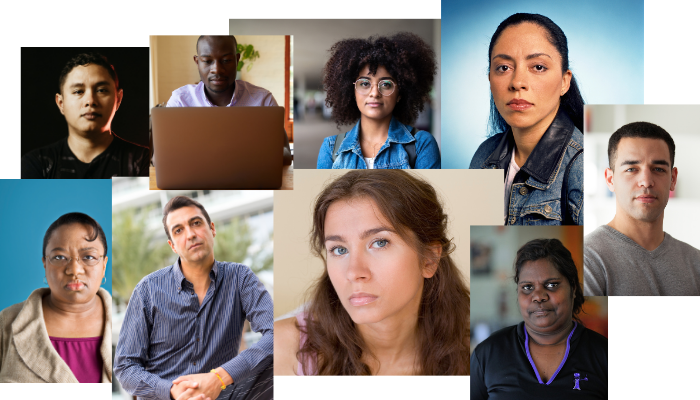
Who are the worldwide workforce of content moderators?
There is no single transparent global register of CMs. Much of the workforce remains hidden behind outsourcing chains and limited public reporting but it is a large and internationally dispersed workforce. There are around 15,000 people moderating Facebook and Instagram, with the overwhelming majority employed by third-party vendors, while about 10,000 were reviewing YouTube and other Google products.
This workforce operates across multiple regions, including the United States, the Philippines, India, Ireland, Portugal, Spain, Germany, Latvia, Kenya and elsewhere. It is multilingual and cross-cultural and moderators may be required to assess content across languages, dialects, cultural references and legal or policy frameworks that extend beyond their own immediate background, increasing the complexity and the burden of the role.
A substantial share of moderation work is carried out through outsourcing and vendor arrangements, often in countries where labour protections, visibility and access to support may be weaker although conditions vary across companies, contracts and local labour markets. What remains consistent is that this large, globally dispersed workforce whose labour is essential to online safety but often under recognised and under supported.
CMs are also not a uniform workforce. They differ by age, gender, geography, language, employment status and life circumstances and these factors may shape how workers experience risk, support and safety in the role.
Types of decisions and materials
CMs do not only review obviously illegal material. Their work often spans several different categories of content and requires a mixture of policy knowledge, contextual judgement and rapid decision-making. In practice, this work often involves reviewing large volumes of content at speed, making repeated decisions under time pressure and moving quickly between very different kinds of material. Some cases are straightforward, but many are ambiguous, distressing or context dependent. Automated systems may filter content before it reaches a human reviewer, but human judgement remains necessary where content or context is complex.
1
Clearly illegal and highly harmful content: This can include child sexual abuse material, terrorist content, fraud, assaults, murders, the sale of illegal drugs or weapons and content encouraging suicide or self-harm. Regulators explicitly identify these as among the forms of illegal content services must address
2
Content that violates platform community standards: Moderators are often asked to assess material that breaches platform rules even where it may not meet a criminal threshold. This can include hate speech, bullying and harassment, violent and graphic content, nudity or sexual activity, child safety violations, impersonation, spam and misleading content
3
Policy decisions that require contextual judgement: Much moderation is not a simple decision. Reviewers may need to decide whether a post is abusive, threatening, exploitative or violative in context. For example, bullying and harassment decisions often depend on factors such as intent, repetition and whether the target is a public or private individual
4
Legal but harmful or borderline content: Moderators and Trust & Safety teams may also handle material that is not necessarily illegal but may still create risk, especially for children. Regulatory frameworks distinguish between illegal content and content that may be harmful to children, while platforms may reduce, restrict or limit certain harmful but lawful material under their own safety rules
5
Material involving children that may not be straightforward to assess: Some cases involve safety risks to children that sit across several categories at once, such as grooming indicators or material that may require escalation to specialist teams rather than a simple decision to either remove or leave the material. This is one way the role combines exposure to harmful material with complex judgement under pressure
Because this work is often repetitive, high volume and fast paced, the cumulative impact of reviewing harmful material over time may be as important as any single piece of content.


Why public awareness is needed
- Most parents, teachers and everyday users do not see the worst material online because someone else has already reviewed it and acted on it
- That hidden workforce includes moderators and Trust & Safety staff who identify and remove illegal or harmful content, including content linked to the sexual abuse and exploitation of children
- The role is not peripheral to online safety, it is part of the human infrastructure that helps protect children and prevents harmful, potentially traumatic material from reaching wider audiences
- Public discussion usually focuses on platforms, algorithms and regulation rather than on the people exposed to harmful or potentially traumatic material in order to make online spaces safer
Evidence base
Key findings include:
- Peer-reviewed research shows that repeated exposure to extreme or distressing content is associated with trauma-relevant symptoms and secondary traumatic stress with higher exposure linked to higher psychological distress (Spence et al., 2023; Spence et al., 2024)
- A qualitative study with moderators exposed to child sexual abuse material identified intrusive imagery, triggering, avoidance, hypervigilance and negative cognitive and emotional effects consistent with repeated trauma exposure (Spence et al., 2023)
- A cross-sectional survey of CMs from four lower and middle-income countries found high rates of PTSD symptoms, depression symptoms, somatic symptoms, and alcohol misuse (Gauthier et al., 2026).
- A comparison study found U.S. based CMs had higher PTSD and depression symptoms than colleagues who were not exposed to traumatic content (Gauthier et al., 2026).
- A replication and extension study found that problem-focused and approach-oriented coping strategies, including seeking support from similarly exposed colleagues, were associated with lower psychological distress and secondary trauma and with higher wellbeing while avoidant coping and confidentiality concerns were associated with poorer outcomes (Spence & DeMarco, 2025).
- A practitioner briefing highlighted the importance of peer support, supportive organisational policies, boundaries and recovery, while also underlining that wellbeing services are not a substitute for prevention-oriented controls on exposure and job demands (Spence, Martellozzo, & DeMarco, 2022; Spence & DeMarco, 2025).
Why understanding matters?
- This role helps keep children safe and moderators are often among the first people to identify abusive or exploitative content and are part of the chain that enables removal, reporting and further action
- This role helps protect you from harmful, often traumatic material. The reason most users do not encounter the most disturbing content online is often because another human being has already had to see it
- The psychological cost is real and repeated exposure is associated with distress, posttraumatic stress, and other negative impacts. This should not be treated as an inevitable or invisible part of digital work
- Support alone is not enough and the evidence suggests that care matters but safer work design, reduced exposure, breaks, rotation and trusted support structures are also critical
- Responsibility should be shared. The burden should not rest solely on individual workers. Platforms, employers and policymakers all have a role in preventing avoidable harm.
What better public understanding should lead to?
Greater public awareness would mean recognizing that online safety depends not only on technology and regulation but also on human workers who are exposed to difficult and sometimes traumatic material. It should also mean asking more informed questions about whether platforms and vendors are designing this work safely, including whether workers have realistic: expectations of the work prior to employment, workloads, exposure limits, breaks, peer support, confidential care and safe working conditions. Over time, more transparent public reporting on issues such as exposure, turnover, sickness absence, psychological incidents and support access could help show whether protections are improving in practice.
Selected resources
- Gauthier, G. M., Ali, E., Asim, A., Cornell-Maier, S. & Zoellner, L. A. (2026). I’ve seen enough: Measuring the toll of content moderation on mental health (arXiv:2511.09813) [Preprint]. arXiv. https://doi.org/10.48550/arXiv.2511.09813
- Spence, R., Martellozzo, E. & DeMarco, J. (2022). Coping strategies for content moderators (CATS Content Moderator Brief No. 1, Nov 2022). Middlesex University. https://www.mdx.ac.uk/media/middlesex-university/research-pdfs/Coping-Briefing.pdf
- Spence, R. & DeMarco, J. (2025). Content moderator mental health and associations with coping styles: Replication and extension of previous studies. Behavioral Sciences, 15(4), 487. https://doi.org/10.3390/bs15040487
- Spence, R., Bifulco, A., Bradbury, P., Martellozzo, E. & DeMarco, J. (2024). Content moderator mental health, secondary trauma, and well-being: A cross-sectional study. Cyberpsychology, Behavior, and Social Networking, 27(2), 149-155. https://doi.org/10.1089/cyber.2023.0298
- Spence, R., Bifulco, A., Bradbury, P., Martellozzo, E. & DeMarco, J. (2023). The psychological impacts of content moderation on content moderators: A qualitative study. Cyberpsychology: Journal of Psychosocial Research on Cyberspace, 17(4), Article 8. https://doi.org/10.5817/CP2023-4-8
- DeMarco, J. N., Watson, P. & Norman, S. (2026). Commercial Content Moderation: Trauma exposure on the digital frontline. Journal of Traumatic Stress.